
Newborn care basics: daily routines & first activities (0–3 months)
A calm, practical starter guide to the first months — the small routines that help your baby feel safe, adapt to the world, and develop in a gentle, balanced way.
This guide is informational and advisory only — it is not medical advice and doesn't replace your pediatrician. See the full note at the end.
In this guide

Kangaroo care
How to do it
Undress your baby down to the diaper and lay them chest-to-chest on your bare skin, head turned to one side so breathing stays clear, then cover you both with a light blanket. Settle in for 20–60 minutes in a warm, calm room — during a nap or a quiet evening. This is a perfect job to hand to dad while mum takes time for herself: the comfort comes from any warm chest. Keep baby's face visible and their airway open the whole time.
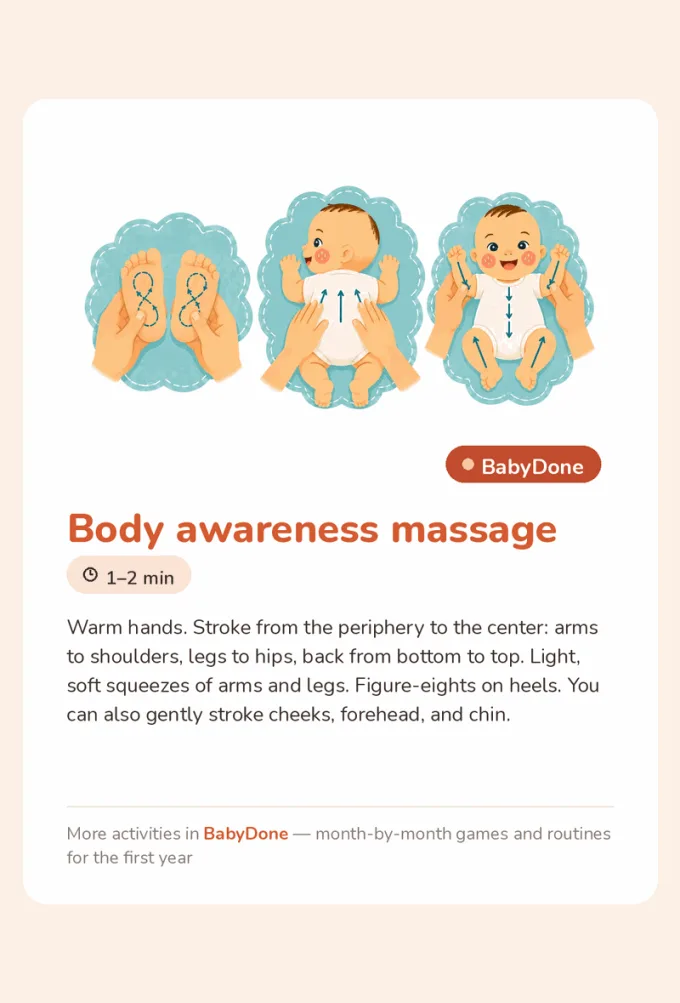
Body awareness massage
How to do it
Warm your hands first, then use slow, light strokes from the edges toward the center — arms toward the shoulders, legs toward the hips, back from the bottom upward. Add soft little squeezes of the arms and legs and small figure-eights on the heels; you can gently stroke the cheeks, forehead and chin too. Keep the pressure feather-light — this is about contact and calm, not deep-tissue work. Watch your baby's face and pause the moment they fuss.
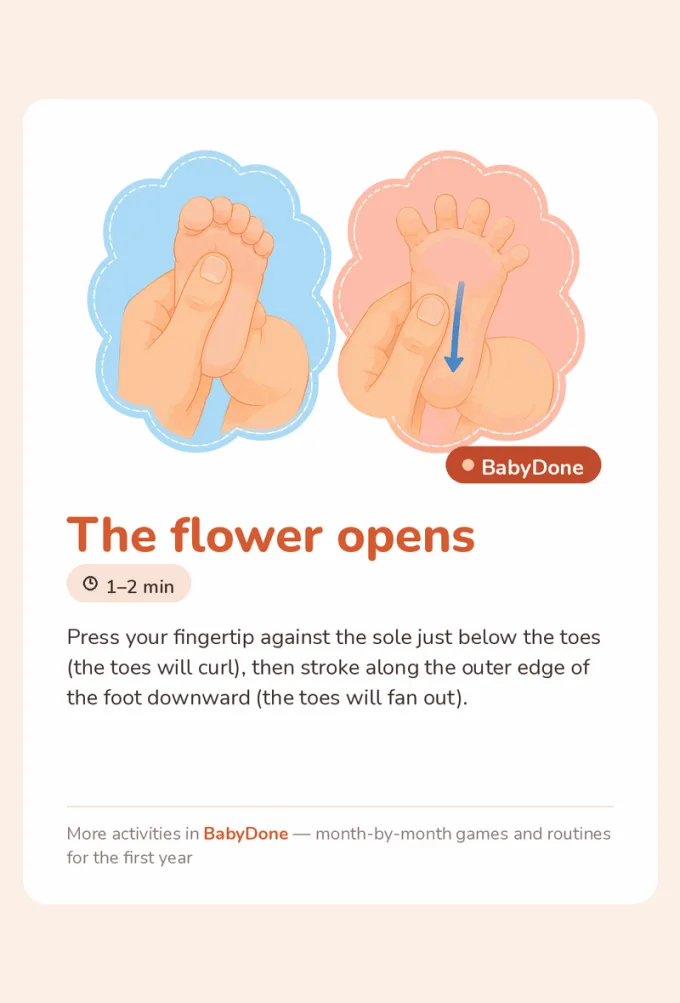
The flower opens
How to do it
This little game plays with two natural newborn reflexes. Press your fingertip into the sole just below the toes and the toes curl in — the flower closes. Then stroke down the outer edge of the foot and the toes fan out — the flower opens. Repeat slowly a few times on each foot, pausing between touches so your baby can feel each one. A minute or two is plenty.
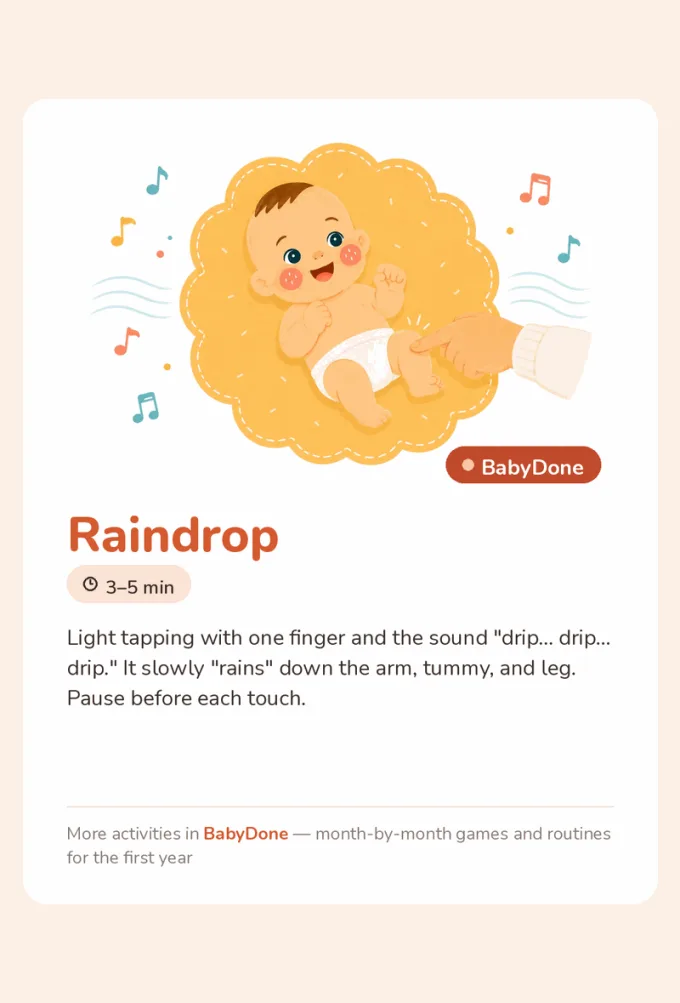
Raindrop
How to do it
This is often a baby's very first game. Tap lightly with one finger while you softly say "drip… drip… drip," letting the rain travel slowly down an arm, across the tummy and down a leg. Pause before each touch so your baby learns to anticipate it. Keep it gentle and unhurried — three to five minutes is more than enough, and a great wind-down before sleep.
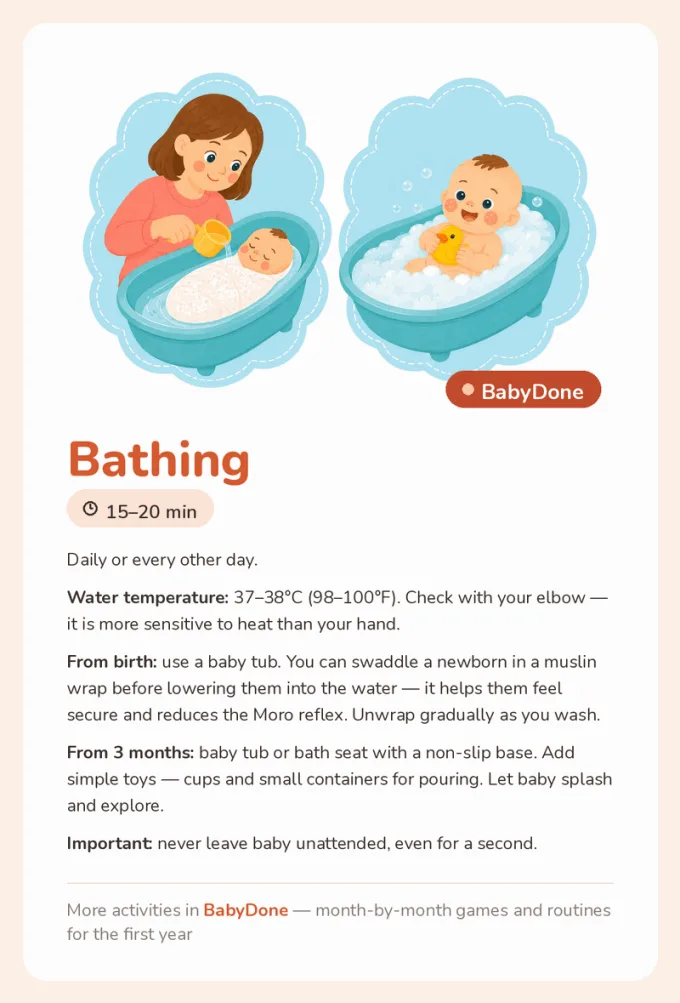
Bathing
How to do it
Keep the water at 37–38°C (98–100°F) and check it with your elbow, which feels heat more accurately than your hand. From birth, use a baby tub; you can swaddle a newborn in a thin muslin before lowering them in — it feels secure and softens the Moro reflex — then unwrap gradually as you wash. At this age bathing is more about relaxation and contact than getting clean, so stay calm and unhurried. Watch the reaction: if water excites your baby, bathe earlier in the day; if it soothes them, make it part of the evening wind-down. Never leave your baby unattended, even for a second.
Air baths
How to do it
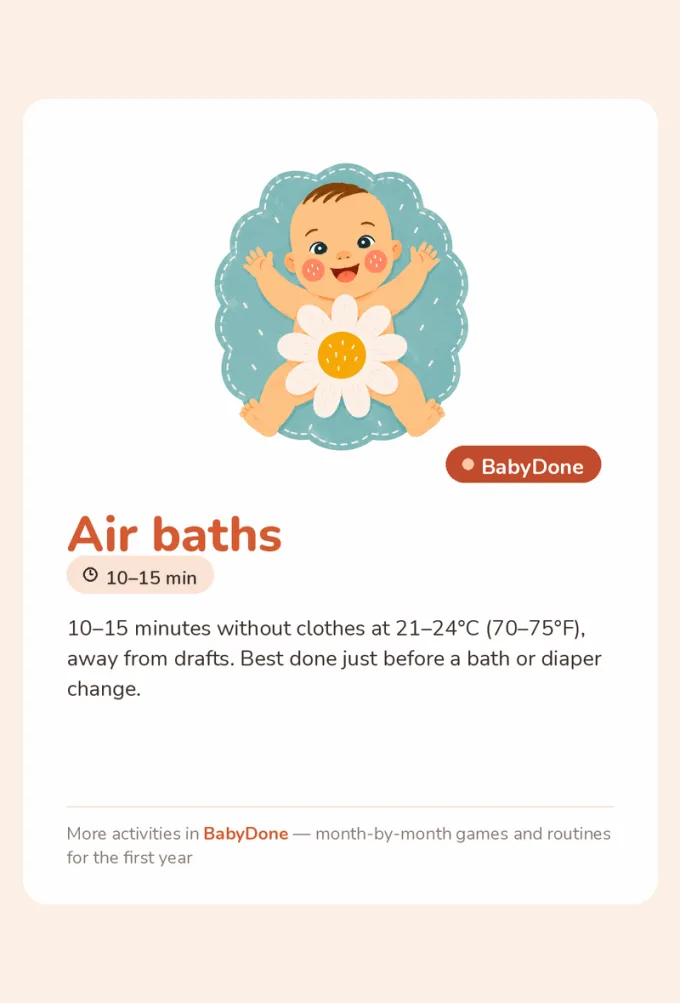
Let your baby lie bare, or in just a diaper, on a soft towel for a few minutes in a warm, draft-free room (around 20–22°C). The easiest moment is during a diaper change — start with 1–2 minutes and build up gradually. Bare-skin time lets the bottom dry out and supports your baby's own temperature regulation. Stop if the skin starts to feel cool or your baby seems uncomfortable.

Vitamin D
How to do it
The WHO and AAP recommend a daily vitamin D supplement for breastfed and mixed-fed babies, since breast milk alone doesn't provide enough — commonly 400 IU per day from the first days of life. The exact dose can vary from baby to baby, so it's important to discuss it with your doctor before you start. Once you have their go-ahead, giving it at the same moment each day — for example, right before a feed — helps it become an automatic habit.
Potty cue
How to do it
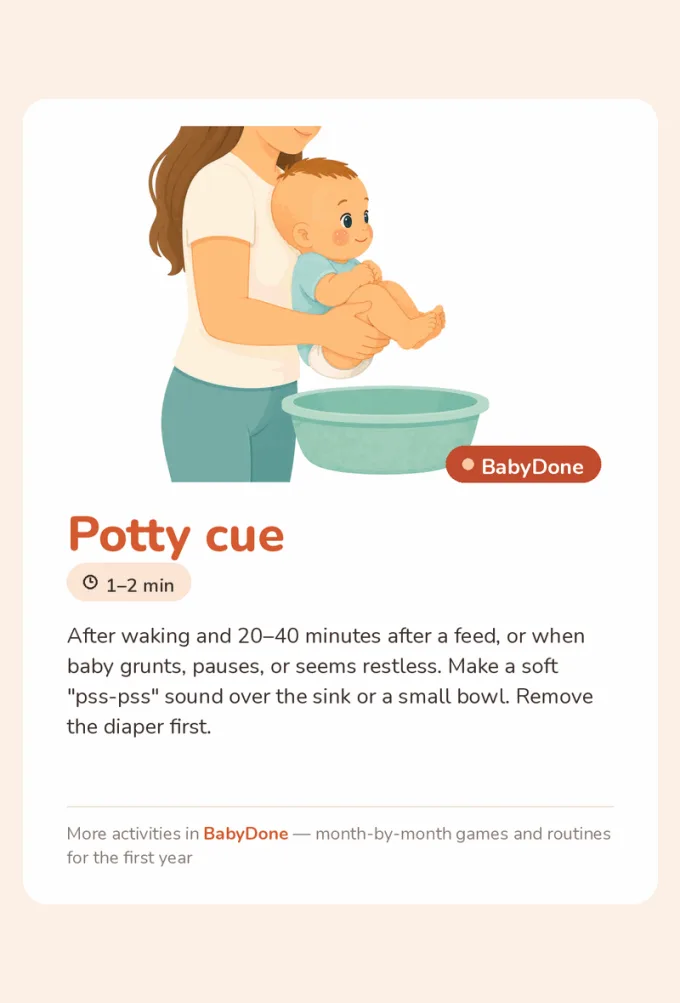
Hold your baby under the knees with their back against your chest, diaper off, over a sink or a small bowl, and make a soft "pss-pss" sound. Good moments are right after waking and 20–40 minutes after a feed, or when baby grunts, pauses or seems restless. It can ease gas and colic and help things move along — if you like, offer the breast or a pacifier to stimulate the reflex. Keep it short (1–3 minutes) and completely pressure-free: your baby doesn't have to "go," this is gentle practice done regularly.
Tummy time
How to do it
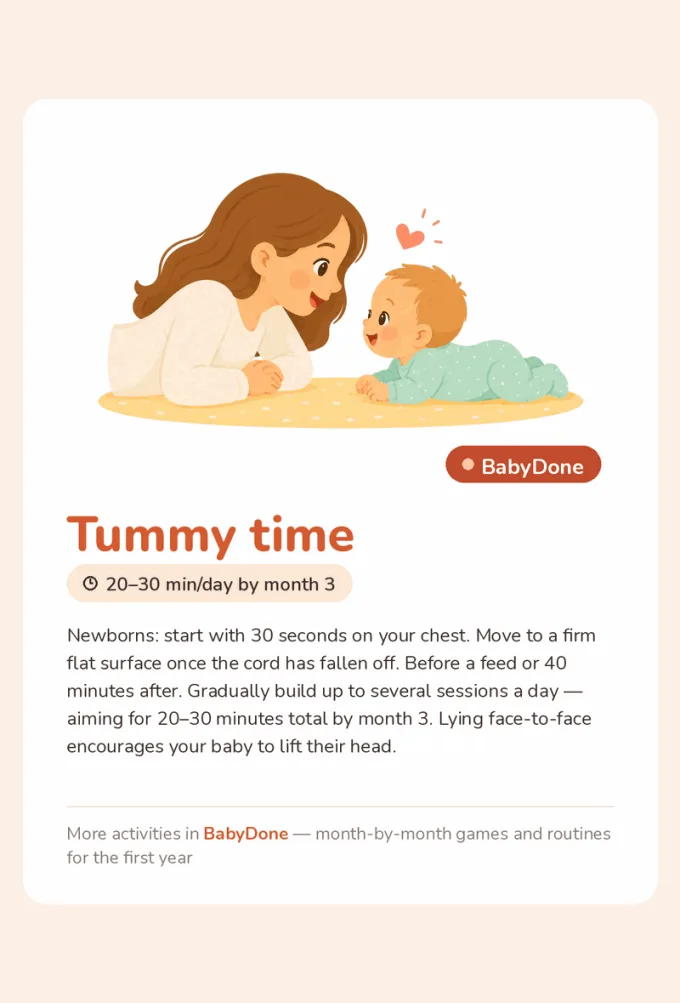
For newborns, start with about 30 seconds lying on your chest, then move to a firm flat surface once the cord stump has healed — before a feed or 40 minutes after one. Build up gradually to several short sessions a day, aiming for 20–30 minutes total by month 3. Make it inviting: lie down face-to-face and talk to your baby, or show black-and-white cards to encourage them to lift and hold their head. Always stay with your baby and keep tummy time to awake moments only.
Black-and-white cards
How to do it
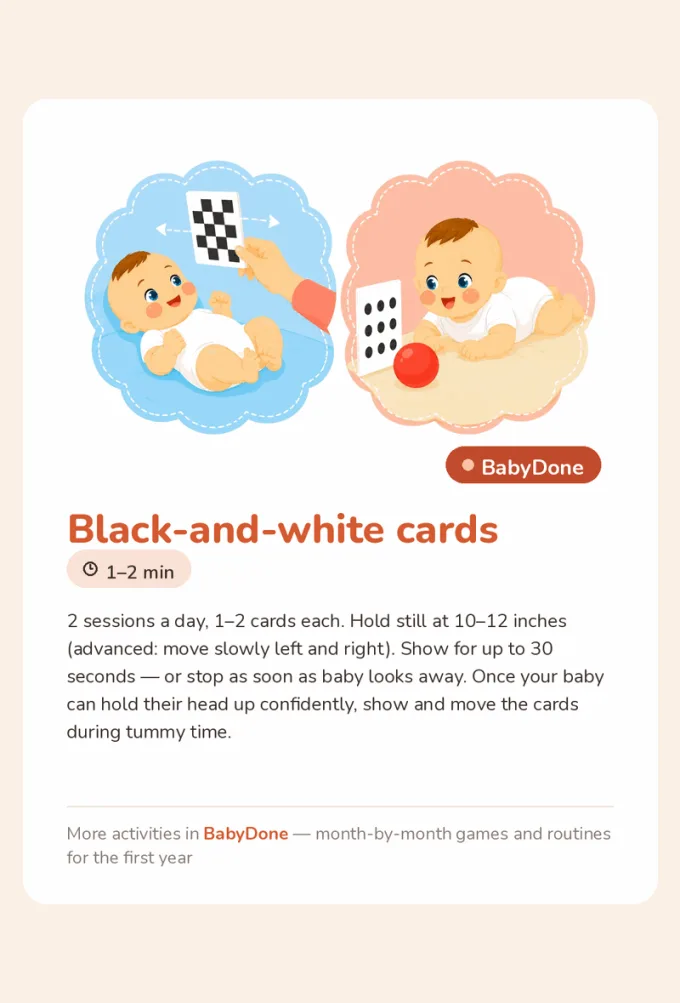
Newborns see high contrast best, so start with age-appropriate black-and-white cards held still about 10–12 inches (25–30 cm) from the face. Do two short sessions a day with one or two cards, up to roughly 30 seconds each — or stop as soon as baby looks away. As they grow, move the card slowly side to side and nearer and farther, then bring it into tummy time to motivate head-lifting. Later you can swap in bold, large colorful shapes.
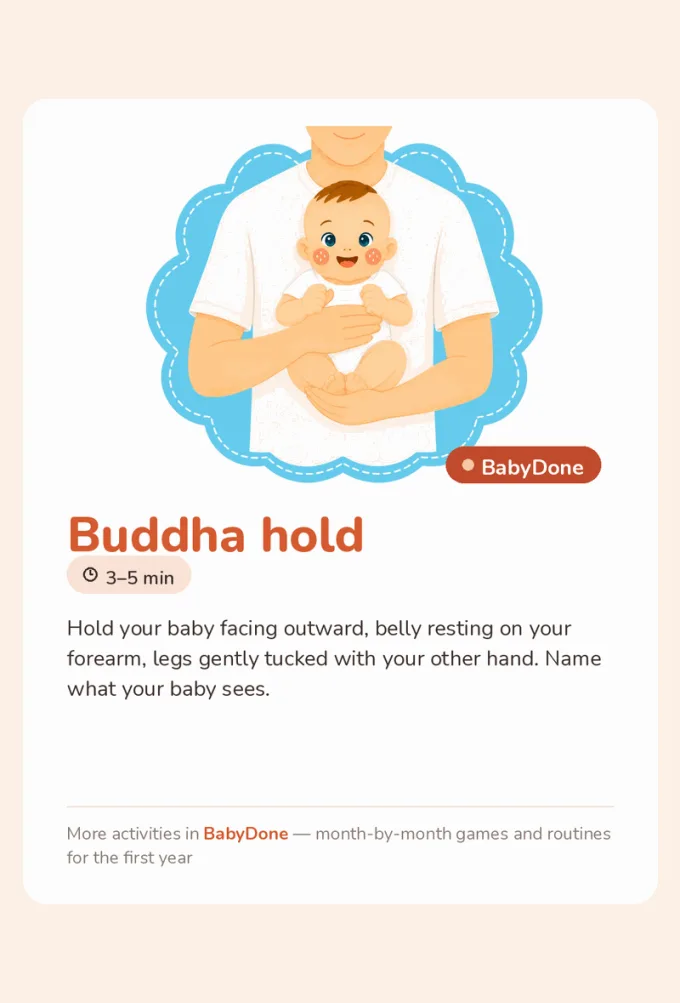
Buddha hold
How to do it
Hold your baby facing outward with their back against your chest: their bottom and belly rest on one of your forearms, legs gently tucked, while your other hand supports across the chest. Keep them symmetrical and walk or sway smoothly. Name what your baby sees as you move around. The outward view plus gentle motion often calms a fussy baby and feeds their growing sense of space.
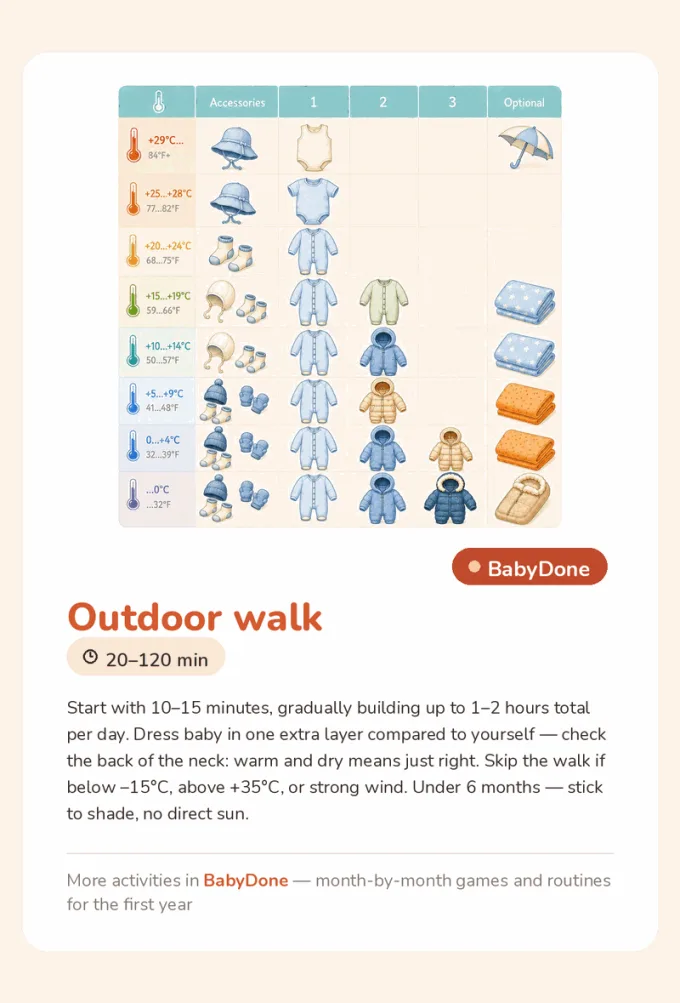
Outdoor walk
How to do it
Start with 10–15 minutes and gradually build up to 1–2 hours total across the day. Dress your baby in one extra layer compared with yourself, then check the back of the neck — warm and dry means just right (the card's temperature chart makes layering easy). Skip the walk below about −15°C, above +35°C, or in strong wind. For babies under 6 months, stay in the shade with no direct sun.
Important — please read. This article is for general information only and is advisory in nature. The activities and descriptions are based on publicly available child-development and care guidance, including recommendations published by organizations such as the World Health Organization (WHO) and the American Academy of Pediatrics (AAP).
These organizations have not reviewed, approved or endorsed this article, BabyDone, or its content, and no affiliation or partnership is implied. Any organization names are used for identification and reference only and remain the trademarks of their respective owners.
Nothing here is medical advice and it does not replace a personal consultation with a qualified pediatrician or other specialist. Every baby is different — check with your doctor before starting any new routine or supplement (including vitamin D), follow their guidance, and stop and seek advice if anything worries you. Always supervise your baby closely, especially during bathing and tummy time, and seek urgent medical care in an emergency. By using these suggestions you accept that you do so at your own discretion and responsibility.